Nomina Font Family & Specimen - Tokotype

Nomina

Nomina

Nomina Styles

Uprights

ExtraLight

Light

Regular

Medium

SemiBold

Bold

ExtraBold

Black

Nomina Styles

Italics

ExtraLight Italic

Light Italic

Italic

Medium Italic

SemiBold Italic

Bold Italic

ExtraBold Italic

Black Italic

172px

0px

1em

Future Metrics

160px

0px

1em

MEMORY Decimal ↓ April 1, 2027

104px

0px

1em

British Standard Colour (BS) EXT.2015

16px

0px

1.3em

Over 1400 years the Romans and other peoples of Italy employed a system of names which were different from the personal names used by other cultures in Europe, consisting of a combination of a personal and a family name. Although conventionally referred to as the tria nomina, the combination of praenomen, nomen, and cognomen that have come to be regarded as the basic elements of the classical Roman name-form in fact represent a continuous process of development, from at least the 7th century BC – 7th century AD. The names that developed as part of this system became a defining characteristic of Roman civilization, and although the system itself fell out of use during the Early Middle Ages, the names themselves had a profound influence on the development of European naming practices, and many continue to influence modern languages. The distinguishing feature of Roman nomenclature was the use of both personal names and regular surnames. Throughout Europe and the Mediterranean, other ancient civilizations distinguished individuals using single personal names. These names usually combined two elements or themes which allowed for hundreds or even thousands of possible combinations – a dithematic naming system. But a markedly different system of nomenclature arose in Italy, where the personal name was joined by a hereditary surname. Over time, this binomial system expanded to include additional names and designations. The most important of these names was the nomen gentilicium, or simply nomen, a hereditary surname that identified a person as a member of a distinct gens. This was preceded by the praenomen, or "forename", a personal name that served to distinguish between the different members of a family. For example, a Roman named Publius Lemonius might have sons named Publius Lemonius, Lucius Lemonius, and Gaius Lemonius. Here, Lemonius is the nomen, identifying each person in the family as a member of the gens Lemonia; Publius, Lucius, and Gaius are praenomina used to distinguish between them.

160px

0px

1em

Investor Quality & Global Marketing

24px

0px

1.3em

Naming conventions for women also varied from the classical concept of the tria nomina. Originally Roman women shared the same binomial nomenclature as men; but over time the praenomen became less useful as a distinguishing element, and women's praenomina were gradually discarded, or replaced by informal names. By the end of the Republic, the majority of Roman women either did not have or did not use praenomina. Most women were called by their nomen alone, or by a combination of nomen and cognomen. Praenomina could still be given when necessary, and as with men's praenomina the practice survived well into imperial times, but the proliferation of personal cognomina eventually rendered women's praenomina obsolete.

118px

0px

1em

Paperback +Bespoke Licensed
Variable

172px

0px

1em

Variable
Solid Outline
Glyph Name
Character Name
Unicode Decimal
Unicode Hex

About Font

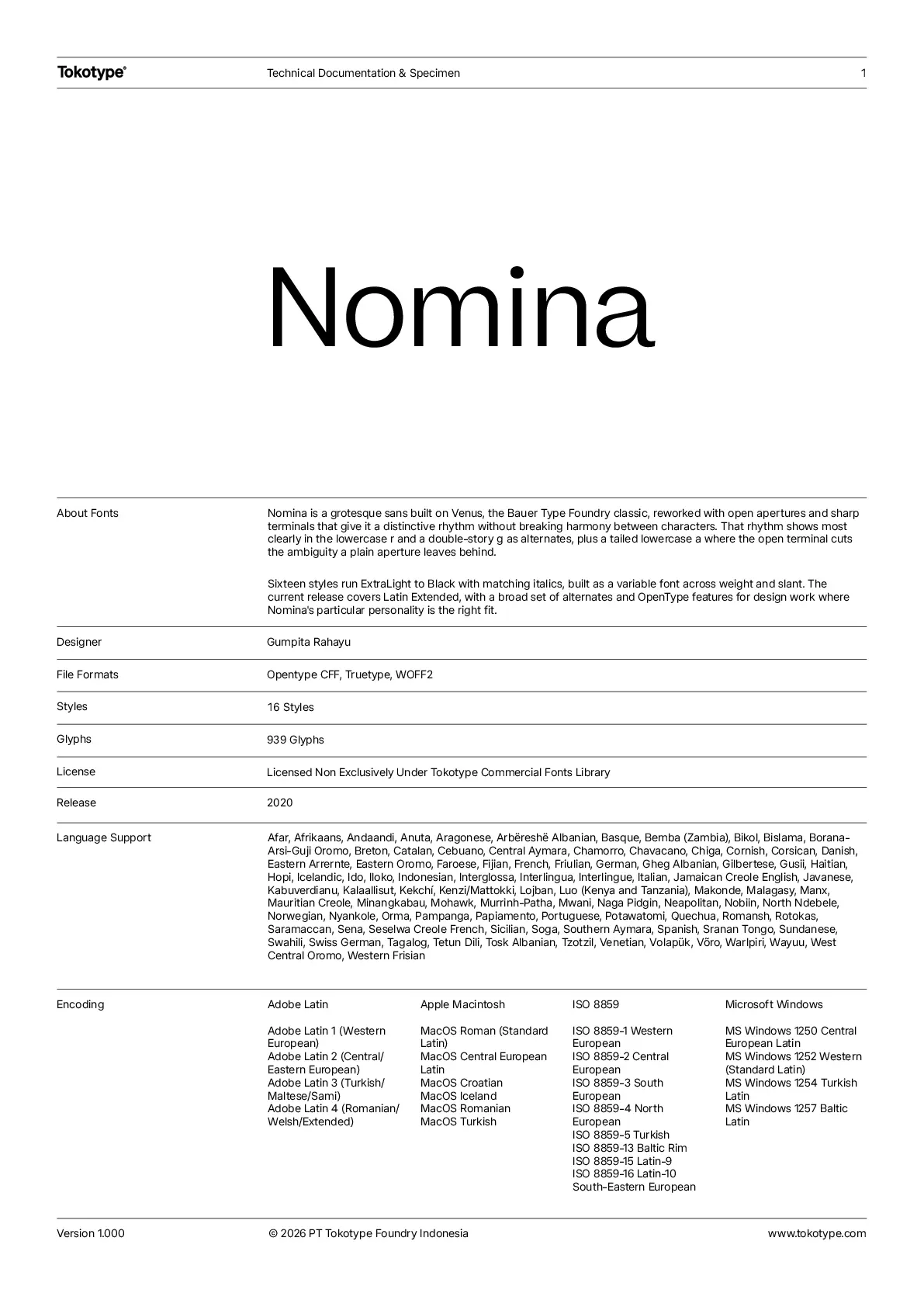
Nomina is a sans-serif type family with a versatile range of weights, from ExtraLight to Black, across 16 styles—including italics. Inspired by classic Grotesk typefaces like Venus by the Bauer Type Foundry, it balances subtle contrast details with open apertures and sharp terminals, lending both clarity and character. These design choices create a distinctive rhythm while maintaining harmony among characters. With a rich set of alternates and OpenType features, Nomina adapts seamlessly to a wide variety of design applications, provided its distinct personality aligns with the intended aesthetic.

Font Information

Collections

16 Styles – Variable

Version

1.5

File Format

OTF, TTF, WOFF2

Designers

Gumpita Rahayu

PDF Specimen

PDF Specimen

Language Supports

Afar
Arvanitika Albanian
Eastern Arrernte
Afrikaans
Aragonese
Asturian
Anuta
Southern Aymara
Central Aymara
North Azerbaijani
Bemba (Zambia)
Bikol
Bislama
Bosnian
Breton
Catalan
Chavacano
Cebuano
Chiga
Chamorro
Chickasaw
Montenegrin
Cornish
Corsican
Seselwa Creole French
Danish
German
Lower Sorbian
Jola-Fonyi
Basque
Faroese
Fijian
French
Western Frisian
Friulian
Borana-Arsi-Guji Oromo
West Central Oromo
Gilbertese
Manx
Swiss German
Wayuu
Gusii
Gwichʼin
Eastern Oromo
Haitian
Hopi
Upper Sorbian
Hungarian
Igbo
Iloko
Indonesian
Icelandic
Italian
Jamaican Creole English
Javanese
Kalaallisut
Makonde
Kabuverdianu
Kekchí
Kaingang
Kirmanjki
Latgalian
Ganda
Luo (Kenya and Tanzania)
Mauritian Creole
Malagasy
Maltese
Mohawk
Maori
Creek
Murrinh-Patha
Kala Lagaw Ya
Naga Pidgin
Neapolitan
North Ndebele
Central Nahuatl
Norwegian
Nyankole
Orma
Pampanga
Papiamento
Portuguese
Potawatomi
Quechua
Cook Islands Māori
Romansh
Rotokas
Sicilian
Sena
Northern Sami
Samoan
Southern Sotho
Spanish
Saramaccan
Sranan Tongo
Serbian
Sundanese
Swahili
Atayal
Tetun Dili
Teso
Tagalog
Tokelau
Tsakhur
Talysh
Tonga (Tonga Islands)
Tzotzil
Uighur
Venetian
Vietnamese
Võro
Walser
Warlpiri
Mwani
Soga
Minang
Yoruba
Zapotec.

Download Trial Fonts for Free

Take our fonts for a spin! Enter your name, email address, and the font of your choice. Then, you can download it directly and start testing it for your project.