Gramatika Font Family & Specimen - Tokotype

Gramatika

Gramatika

Gramatika Styles

Uprights

ExtraLight

Light

Regular

Medium

SemiBold

Bold

ExtraBold

Black

Gramatika Styles

Italics

ExtraLight Italic

Light Italic

Italic

Medium Italic

SemiBold Italic

Bold Italic

ExtraBold Italic

Black Italic
Variable

400px

0px

1em

Knighthood

400px

0px

1em

Conductors

72px

0px

1em

Astrological

400px

0px

1em

Библиотека

400px

0px

1em

Αυτογνωσία

48px

0px

1.2em

In grammar, an article is any of a small set of words or affixes (such as a, an, and the in English) used with nouns to limit or give definiteness to the application. The category of articles constitutes a part of speech.

24px

0px

1.4em

A definite article is an article that marks a definite noun phrase. Definite articles, such as the English the, are used to refer to a particular member of a group. It may be something that the speaker has already mentioned, or it may be something uniquely specified. For example, Sentence 1 uses the definite article and thus expresses a request for a particular book. In contrast, Sentence 2 uses an indefinite article and thus conveys that the speaker would be satisfied with any book. Some languages (such as the continental North Germanic languages, Bulgarian or Romanian) have definite articles only as suffixes. Indefinites can also be used to refer to specific entities whose precise identity is unknown or unimportant. A friend of mine told me that happens frequently to people who live on Sesame Street. Indefinite noun phrases are widely studied within linguistics, in particular because of their ability to take exceptional scope. A proper article indicates that its noun is proper, and refers to a unique entity. It may be the name of a person, the name of a place, the name of a planet, etc. The Māori language has the proper article a, which is used for personal nouns; so, "a Pita" means "Peter". In Māori, when the personal nouns have the definite or indefinite article as an important part of it, both articles are present; for example, the phrase "a Te Rauparaha", which contains both the proper article a and the definite article Te refers to the person named Te Rauparaha.

16px

0px

1.4em

This article outlines the grammar of the Dutch language, which shares strong similarities with German grammar and also, to a lesser degree, with English grammar. Vowel length is indicated in Dutch spelling using a combination of double vowels and double consonants. Changes from single to double letters are common when discussing Dutch grammar, but they are entirely predictable once one knows how the spelling rules work. That means that the spelling alternations do not form part of the grammar, and they are not discussed here. For more information, see Dutch orthography. Dutch word order is underlyingly SOV (subject–object–verb). There is an additional rule called V2 in main clauses, which moves the finite (inflected for subject) verb into the second position in the sentence. That makes sentences with only one verb appear with SVO (subject–verb–object) or VSO (verb–subject–object) order. However, any other verbs or verbal particles are placed at the end of the clause in accordance with the underlying SOV order, giving an intermediate order of SVOV(V)(V)... In imperative sentences, the verb of the main clause is always placed first, although it may be preceded by a noun phrase indicating who is being addressed. In Dutch, nouns are marked for number in singular and plural. Cases have largely fallen out of use, as have the endings that were used for them. Standard Dutch has three genders: masculine, feminine and neuter. However, in large parts of the Netherlands there is no grammatical distinction between what were originally masculine and feminine genders, and there is only a distinction between the resultant common and neuter. Gender is not overtly marked on nouns either, and must be learned for each noun. Words ending in a schwa /ə/ often use -s, but a sizable number use -n, particularly if they are older. Some nouns may allow either ending. Nouns that are substantivised forms of adjectives always use -n. Relatively modern words ending in a long vowel use -'s (with an apostrophe), but if they end in -ee or -é then no apostrophe is used. Older ones generally use -en or -ën (with diaeresis). Words ending in unstressed -el or -er usually use -s. If -en is allowed it tends to be more archaic or poetic. A number of common nouns inherited from Old Dutch have a short vowel in the singular but a long vowel in the plural. When short i is lengthened in that way, it becomes long e. Dutch orthography uses the Latin alphabet. The spelling system is issued by government decree and is compulsory for all government documentation and educational establishments. In the Netherlands, the official spelling is regulated by the Spelling Act of 15 September 2005. This came into force on 22 February 2006, replacing the Act on the Spelling of the Dutch Language of 14 February 1947. The Spelling Act gives the Committee of Ministers of the Dutch Language Union the authority to determine the spelling of Dutch by ministerial decision. In addition, the law requires that this spelling be followed "at the governmental bodies, at educational institutions funded from the public purse, as well as at the exams for which legal requirements have been established". In other cases, it is recommended, but it is not mandatory to follow the official spelling.
Solid Outline
Glyph Name
Character Name
Unicode Decimal
Unicode Hex

About Font

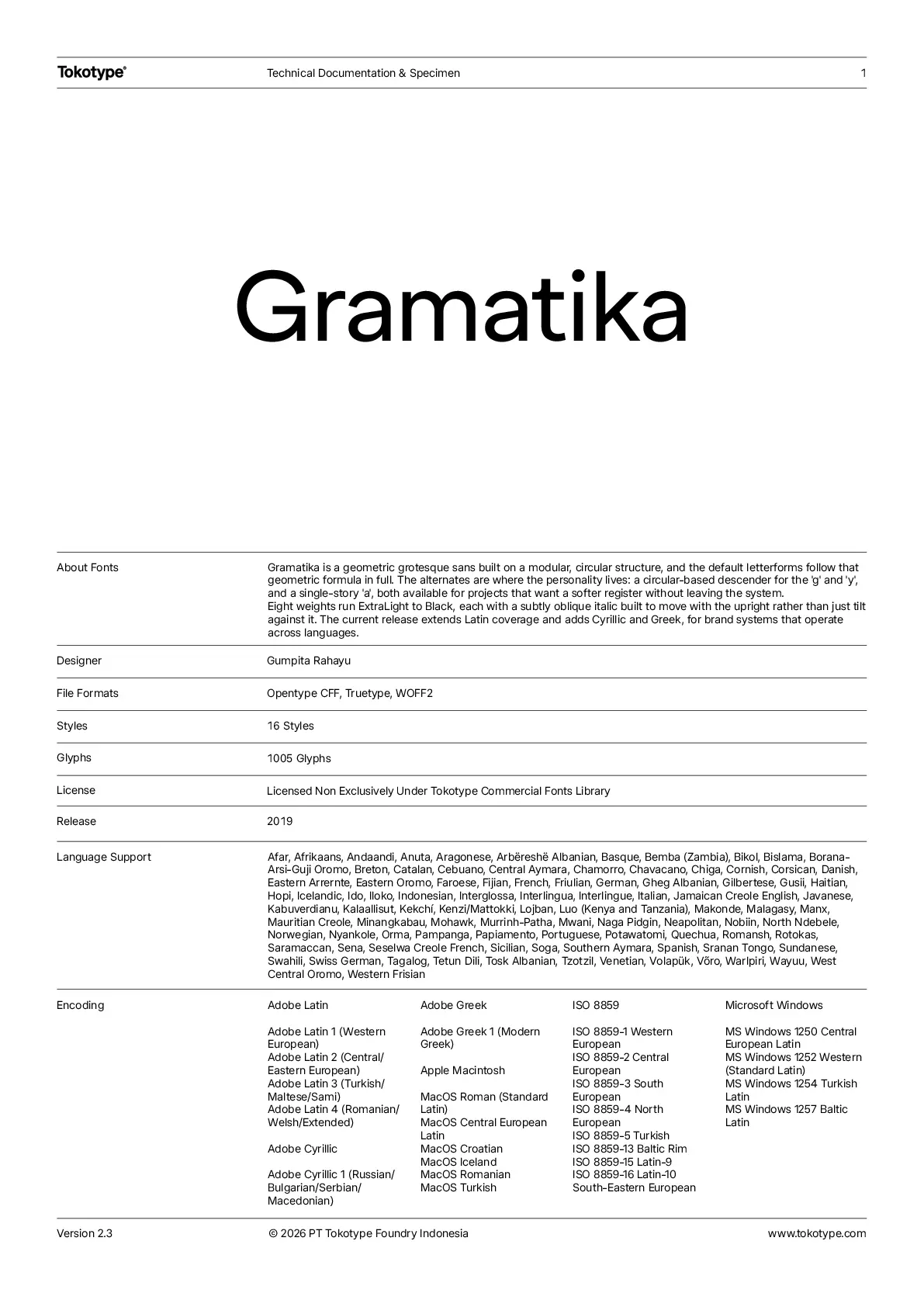
Gramatika is a geometric grotesque sans built on a modular, circular structure, and the default letterforms follow that geometric formula in full. The alternates are where the personality lives: a circular-based descender for the 'g' and 'y', and a single-story 'a', both available for projects that want a softer register without leaving the system.


Eight weights run ExtraLight to Black, each with a subtly oblique italic built to move with the upright rather than just tilt against it. The current release extends Latin coverage and adds Cyrillic and Greek, for brand systems that operate across languages.

Font Information

Collections

16 Styles – Variable

Version

2.003

File Format

OTF, TTF, WOFF2

Designers

Gumpita Rahayu

PDF Specimen

PDF Specimen

Language Supports

Afar
Afrikaans
Andaandi
Dongolawi
Anuta
Aragonese
Arbëreshë Albanian
Asturian
Atayal
Basque
Bemba (Zambia)
Bikol
Bislama
Borana-Arsi-Guji Oromo
Bosnian
Breton
Catalan
Cebuano
Central Aymara
Chamorro
Chavacano
Chiga
Cook Islands Māori
Cornish
Corsican
Creek
Czech
Danish
Eastern Arrernte
Eastern Oromo
Faroese
Fijian
French
Friulian
Ganda
German
Gheg Albanian
Gilbertese
Gusii
Haitian
Hopi
Hungarian
Hän
Icelandic
Igbo
Iloko
Indonesian
Italian
Jamaican Creole English
Javanese
Jola-Fonyi
Kabuverdianu
Kaingang
Kala Lagaw Ya
Kalaallisut
Kekchí
Kenzi
Mattokki
Kirmanjki
Latgalian
Lower Sorbian
Luo (Kenya and Tanzania)
Makonde
Malagasy
Maltese
Manx
Maori
Mauritian Creole
Minangkabau
Mohawk
Montenegrin
Murrinh-Patha
Mwani
Naga Pidgin
Neapolitan
Nobiin
North Ndebele
Northern Sami
Norwegian
Nyankole
Orma
Pampanga
Papiamento
Polish
Portuguese
Potawatomi
Quechua
Romanian
Romansh
Rotokas
Samoan
Saramaccan
Sena
Seselwa Creole French
Sicilian
Slovak
Slovenian
Soga
Southern Aymara
Southern Sotho
Spanish
Sranan Tongo
Sundanese
Swahili
Swiss German
Tagalog
Tetun Dili
Tokelau
Tonga (Tonga Islands)
Tosk Albanian
Tuvalu
Tzotzil
Upper Sorbian
Venetian
Vietnamese
Võro
Walser
Warlpiri
Wayuu
West Central Oromo
Western Frisian
Yoruba
Zapotec
Abaza
Bulgarian
Erzya
Moksha
Nogai
Russian
Modern Greek

Download Trial Fonts for Free

Take our fonts for a spin! Enter your name, email address, and the font of your choice. Then, you can download it directly and start testing it for your project.