Frasa Font Family & Specimen - Tokotype

Frasa

Frasa

Frasa Styles

Uprights

Regular

Medium

SemiBold

Bold

ExtraBold

Black

Frasa Styles

Italics

Italic

Medium Italic

SemiBold Italic

Bold Italic

ExtraBold Italic

Black Italic

Variable

400px

0px

1em

Millimetre
Variable Italic

400px

0px

1em

Pinpointed

400px

0px

1em

Recirculate

400px

0px

1em

Quaternion

48px

0px

1.2em

A laconic phrase or laconism is a concise or terse statement, especially a blunt and elliptical rejoinder. It is named after Laconia, the region of Greece including the city of Sparta, whose ancient inhabitants had a reputation for verbal austerity and were famous for their often pithy remarks.

24px

0px

1.4em

In grammar, a phrase — called an expression in some contexts — is a group of one or more words acting as a grammatical unit. It can be used within a sentence, so this means that a phrase can be treated as a unit within a larger structure. For instance, the English sentence "the squirrel is very happy" is a clause phrase which contains the noun phrase "the squirrel" and the verb phrase "is very happy". Additionally, "very happy" is an adjective phrase. Phrases can consist of a single word or a complete sentence. In theoretical linguistics, phrases are often analyzed as units of syntactic structure such as a constituent. There is a difference between the common use of the term phrase and its technical use in linguistics. In common usage, a phrase is usually a group of words with some special idiomatic meaning or other significance, such as "all rights reserved", "economical with the truth", or "kick the bucket". It may be a euphemism, a saying or proverb, a fixed expression, a figure of speech, etc. In linguistics, these are known as phrasemes. In theories of syntax, a phrase is any group of words, or sometimes a single word, which plays a particular role within the syntactic structure of a sentence. It does not have to have any special meaning or significance, or even exist anywhere outside of the sentence being analyzed, but it must function there as a complete grammatical unit. For example, in the sentence Yesterday I saw an orange bird with a white neck, the words an orange bird with a white neck form a noun phrase, or a determiner phrase in some theories, which functions as the object of the sentence. Many theories of syntax and grammar illustrate sentence structure using phrase 'trees', which provide schematics of how the words in a sentence are grouped and relate to each other. A tree shows the words, phrases, and clauses that make up a sentence. Any word combination that corresponds to a complete subtree can be seen as a phrase. The tree on the left is of the constituency-based, phrase structure grammar, and the tree on the right is of the dependency grammar. The node labels in the two trees mark the syntactic category of the different constituents, or word elements, of the sentence. In the constituency tree each phrase is marked by a phrasal node (NP, PP, VP); and there are eight phrases identified by phrase structure analysis in the example sentence. On the other hand, the dependency tree identifies a phrase by any node that exerts dependency upon, or dominates, another node. And, using dependency analysis, there are six phrases in the sentence. The trees and phrase-counts demonstrate that different theories of syntax differ in the word combinations they qualify as a phrase. Here the constituency tree identifies three phrases that the dependency trees does not, namely: house at the end of the street, end of the street, and the end. More analysis, including about the plausibilities of both grammars, can be made empirically by applying constituency tests.

16px

0px

1.4em

In linguistics, an adverbial phrase ("AdvP") is a multi-word expression operating adverbially: its syntactic function is to modify other expressions, including verbs, adjectives, adverbs, adverbials, and sentences. Some grammars use the label adverb phrase to denote an adverbial phrase composed entirely of adverbs versus an adverbial phrase, which might not contain an adverb. The following examples illustrate some of the most common types of adverbial phrases. All adverbial phrases appear in bold; when relevant, the head of each adverbial phrase appears in square brackets. The heads of each of the following adverbial phrases are degree adverbials (written "Deg" in syntactic trees). Degree adverbials modify adjacent adverbs (that is, an adverb that is lower in the syntactic tree than the degree adverbial). Degree adverbials are commonly used in English to convey the intensity, degree, or focusing of an adjacent adverb. In most cases, a degree adverbial is used to modify an adverb in an adverbial phrase: for example, in (1) the degree adverbial very modifies the adverb quickly; in (2) the degree adverbial extremely modifies the adverb hard; in (3) the degree adverbial really modifies the adverb well; and in (4), the degree adverbial so modifies the adverb soon. Modifying adverbial phrases combine with a sentence, and the removal of the adverbial phrase yields a well-formed sentence. For example, in (5) the modifying adverbial phrase in an hour can be removed, and the sentence remains well-formed (e.g., I'll go to bed); in (6) the modifying AdvP three hours later can be omitted, and the sentence remains well-formed (e.g., We arrived); and in (7), the modifying AdvP before long can be omitted, and the sentence remains well-formed (e.g. The situation had been resolved). Just as adjective phrases function attributively to give additional information about an adjacent noun, the modifying adverbial phrases illustrated in (5) to (7) function as secondary predicates that give additional temporal information about the sentence. Complement adverbial phrases are much less common than their modifying counterparts. Adverbial phrases functioning as complements usually arise when an adverb licenses a complement as a selectional requirement. Nearly all of these complements license an adjoining prepositional phrase. Below are a few examples of complement adverbial phrases. (9) Foreign firms in US markets are treated [equally] with their US counterparts. The following sentences illustrate the difference between adverbs, adverbial phrases, and adverbial clauses. In the first example, "soon" is an adverb (as distinct from a noun or a verb), which is a type of adverbial. In the second sentence, the modifying phrase "in an hour" has the same syntactic function (that is, to act adverbially and modify the base of the sentence "I'll go to bed"), though it does not contain an adverb. This modifying phrase includes a preposition and a determiner phrase, and functions as an adverbial, thus making it an adverbial phrase. In the third example, we see a whole clause functioning as an adverbial; it is termed an adverbial clause. Functionally, the term adverbial refers to all structures that can take the position of an adverb on a phrase structure level.
Solid Outline
Glyph Name
Character Name
Unicode Decimal
Unicode Hex

About Font

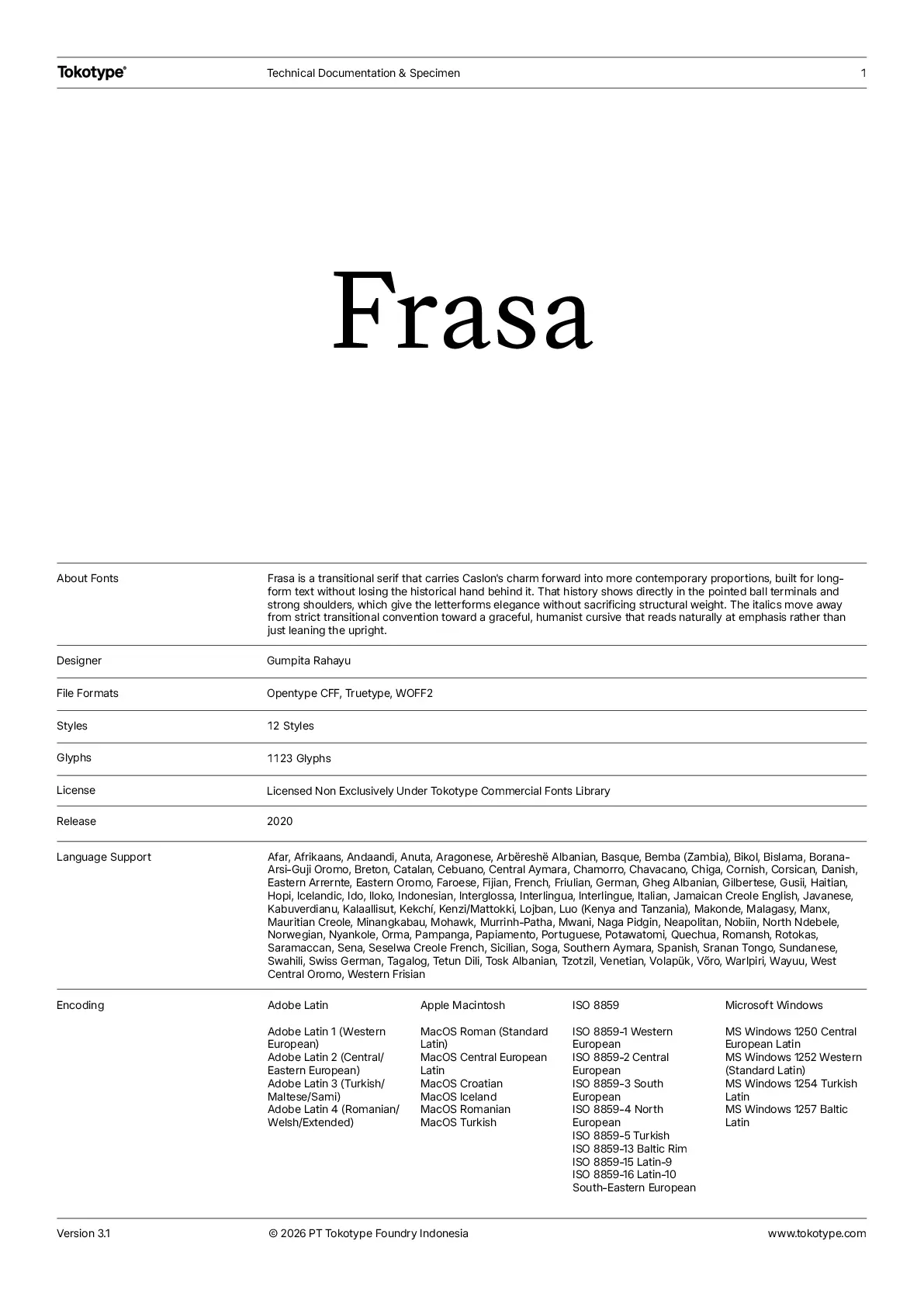
Frasa is a contemporary serif family that blends the charm of Caslon with subtle transitional influences. Designed for versatility, it balances refined proportions for long-form text. Its character is shaped by historical traditions, evident in details like pointed ball terminals and strong shoulders, which add both elegance and strength. The italics introduce a graceful, humanist touch, inspired by natural cursive forms that enhance emphasis and readability. With features like small caps, old-style figures, and ligatures, Frasa meets the demands of classic typography while serving as a powerful tool for both editorial and expressive design.

Font Information

Collections

12 Styles – Variable

Version

3.2

File Format

OTF, TTF, WOFF2

Designers

Gumpita Rahayu

PDF Specimen

PDF Specimen

Language Supports

Afar
Arvanitika Albanian
Eastern Arrernte
Afrikaans
Aragonese
Asturian
Anuta
Southern Aymara
Central Aymara
North Azerbaijani
Bemba (Zambia)
Bikol
Bislama
Bosnian
Breton
Catalan
Chavacano
Cebuano
Chiga
Chamorro
Chickasaw
Montenegrin
Cornish
Corsican
Seselwa Creole French
Danish
German
Lower Sorbian
Jola-Fonyi
Basque
Faroese
Fijian
French
Western Frisian
Friulian
Borana-Arsi-Guji Oromo
West Central Oromo
Gilbertese
Manx
Swiss German
Wayuu
Gusii
Gwichʼin
Eastern Oromo
Haitian
Hopi
Upper Sorbian
Hungarian
Igbo
Iloko
Indonesian
Icelandic
Italian
Jamaican Creole English
Javanese
Kalaallisut
Makonde
Kabuverdianu
Kekchí
Kaingang
Kirmanjki
Latgalian
Ganda
Luo (Kenya and Tanzania)
Mauritian Creole
Malagasy
Maltese
Mohawk
Maori
Creek
Murrinh-Patha
Kala Lagaw Ya
Naga Pidgin
Neapolitan
North Ndebele
Central Nahuatl
Norwegian
Nyankole
Orma
Pampanga
Papiamento
Portuguese
Potawatomi
Quechua
Cook Islands Māori
Romansh
Rotokas
Sicilian
Sena
Northern Sami
Samoan
Southern Sotho
Spanish
Saramaccan
Sranan Tongo
Serbian
Sundanese
Swahili
Atayal
Tetun Dili
Teso
Tagalog
Tokelau
Tsakhur
Talysh
Tonga (Tonga Islands)
Tzotzil
Uighur
Venetian
Vietnamese
Võro
Walser
Warlpiri
Mwani
Soga
Minang
Yoruba
Zapotec

Related Family

Frasa Display

Learn More

12 Styles – Variable

Download Trial Fonts for Free

Take our fonts for a spin! Enter your name, email address, and the font of your choice. Then, you can download it directly and start testing it for your project.