Fonetika Mono Font Family & Specimen - Tokotype

Fonetika Mono

Fonetika Mono

Fonetika Mono Styles

Uprights

ExtraLight

Light

Regular

Medium

SemiBold

Bold

ExtraBold

Black

Fonetika Mono Styles

Italics

ExtraLight Italic

Light Italic

Italic

Medium Italic

SemiBold Italic

Bold Italic

ExtraBold Italic

Black Italic

Variable

400px

0px

1em

Authority

400px

0px

1em

Grounding

72px

0px

1em

Meditated

400px

0px

1em

Испанский

400px

0px

1em

Κολλήσεως

24px

0px

1.2em

Voice or voicing is a term used in phonetics and phonology to characterize speech sounds (usually consonants). Speech sounds can be described as either voiceless (otherwise known as unvoiced) or voiced. Voicing can refer to the articulatory process in which the vocal folds vibrate, its primary use in phonetics to describe phones, which are particular speech sounds. It can also refer to a classification of speech sounds that tend to be associated with vocal cord vibration but may not actually be voiced at the articulatory level. That is the term's primary use in phonology: to describe phonemes; while in phonetics its primary use is to describe phones. For example, voicing accounts for the difference between the pair of sounds associated with the English letters <s> and <z>. The two sounds are transcribed as and to distinguish them from the English letters, which have several possible pronunciations, depending on the context. If one places the fingers on the voice box (i.e., the location of the Adam's apple in the upper throat), one can feel a vibration while is pronounced but not with. (For a more detailed, technical explanation, see modal voice and phonation.) In most European languages, with a notable exception being Icelandic, vowels and other sonorants (consonants such as m, n, l, and r) are modally voiced.

16px

0px

1.4em

Japanese phonology is the system of sounds used in the pronunciation of the Japanese language. Unless otherwise noted, this article describes the standard variety of Japanese based on the Tokyo dialect. There is no overall consensus on the number of contrastive individual sounds (phonemes). Common approaches recognize at least 12 distinct consonants (as many as 21 in some analyses) and 5 distinct vowels, /a, e, i, o, u/. Phonetic length is contrastive for both vowels and consonants, and the total length of Japanese words can be measured in a unit of timing called the mora (from Latin mora "delay"). Only limited types of consonant clusters are permitted. Japanese speech also has a pitch accent system in which the position or absence of a pitch drop may determine the meaning of a word: /haꜜsiɡa/, /hasiꜜɡa/, /hasiɡa/. Japanese phonology has been affected by the presence of several layers of vocabulary in the language. In addition to native Japanese vocabulary, Japanese has a large amount of Chinese-based vocabulary (used especially to form technical and learned words, playing a similar role to Latin-based vocabulary in English) and loanwords from other languages. Different layers of vocabulary allow different possible sound sequences (phonotactics). Called wago or yamato kotoba in Japanese, this category consists of inherited native vocabulary. Morphemes in this category show a number of restrictions on structure that may be violated by vocabulary in other layers. Japanese possesses a variety of mimetic words that make use of sound symbolism to serve an expressive function. Like Yamato vocabulary, these words are also of native origin, and can be considered to belong to the same overarching group. However, words of this type show some phonological peculiarities that cause some theorists to regard them as a separate layer of Japanese vocabulary. Called kango in Japanese, words in this stratum originate from several waves of large-scale borrowing from Chinese that occurred from the 6th-14th centuries AD. They comprise 60% of dictionary entries and 20% of ordinary spoken Japanese, ranging from formal vocabulary to everyday words. Most Sino-Japanese words are composed of more than one Sino-Japanese morpheme. Sino-Japanese morphemes have a limited phonological shape: each has a length of at most two moras, which Ito & Mester (2015a) argue reflects a restriction in size to a single prosodic foot. These morphemes represent the Japanese phonetic adaptation of Middle Chinese monosyllabic morphemes, each generally represented in writing by a single Chinese character, taken into Japanese as kanji. Japanese writers also repurposed kanji to represent native vocabulary; as a result, there is a distinction between Sino-Japanese readings of kanji, called On'yomi, and native readings, called Kun'yomi. The moraic nasal /N/ is relatively common in Sino-Japanese, and contact with Middle Chinese is often described as being responsible for the presence of /N/ in Japanese (starting from approximately 800 AD in Early Middle Japanese), although /N/ also came to exist in native Japanese words as a result of sound changes. Called gairaigo in Japanese, this layer of vocabulary consists of non-Sino-Japanese words of foreign origin, mostly borrowed from Western languages after the 16th century; many of them entered the language in the 20th century. In words of this stratum, a number of consonant-vowel sequences that did not previously exist in Japanese are tolerated, which has led to the introduction of new spelling conventions and complicates the phonemic analysis of these consonant sounds in Japanese.
Solid Outline
Glyph Name
Character Name
Unicode Decimal
Unicode Hex

About Font

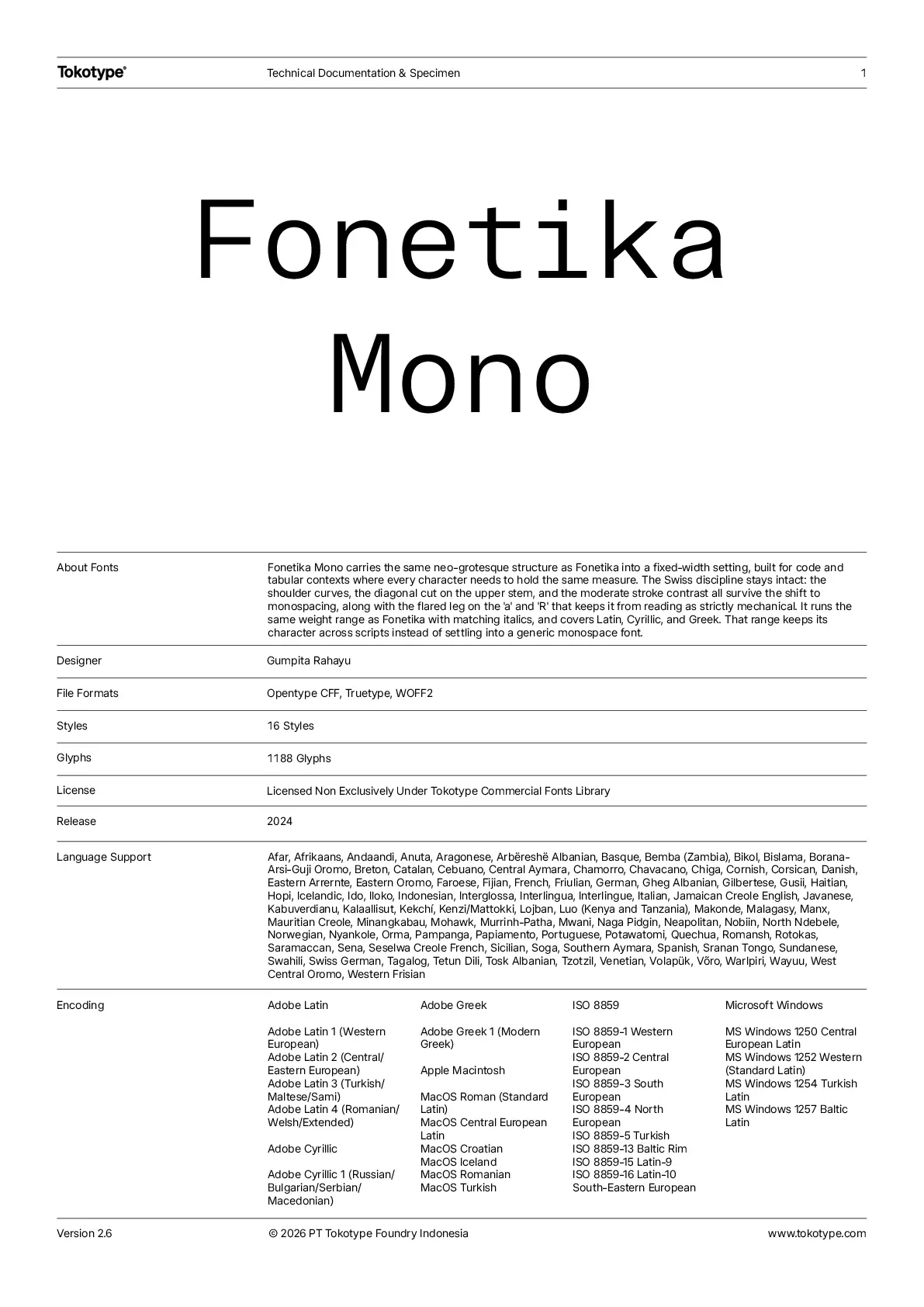
Fonetika Mono carries the same neo-grotesque structure as Fonetika into a fixed-width setting, built for code and tabular contexts where every character needs to hold the same measure. The Swiss discipline stays intact: the shoulder curves, the diagonal cut on the upper stem, and the moderate stroke contrast all survive the shift to monospacing, along with the flared leg on the 'a' and 'R' that keeps it from reading as strictly mechanical. It runs the same weight range as Fonetika with matching italics, and covers Latin, Cyrillic, and Greek. That range keeps its character across scripts instead of settling into a generic monospace font.

Font Information

Collections

16 Styles – Variable

Version

2.6

File Format

OTF, TTF, WOFF2

Designers

Gumpita Rahayu

PDF Specimen

PDF Specimen

Language Supports

Afar
Afrikaans
Andaandi
Dongolawi
Anuta
Aragonese
Arbëreshë Albanian
Asturian
Atayal
Basque
Bemba (Zambia)
Bikol
Bislama
Borana-Arsi-Guji Oromo
Bosnian
Breton
Catalan
Cebuano
Central Aymara
Chamorro
Chavacano
Chiga
Cook Islands Māori
Cornish
Corsican
Creek
Czech
Danish
Eastern Arrernte
Eastern Oromo
Faroese
Fijian
French
Friulian
Ganda
German
Gheg Albanian
Gilbertese
Gusii
Haitian
Hopi
Hungarian
Hän
Icelandic
Igbo
Iloko
Indonesian
Italian
Jamaican Creole English
Javanese
Jola-Fonyi
Kabuverdianu
Kaingang
Kala Lagaw Ya
Kalaallisut
Kekchí
Kenzi
Mattokki
Kirmanjki
Latgalian
Lower Sorbian
Luo (Kenya and Tanzania)
Makonde
Malagasy
Maltese
Manx
Maori
Mauritian Creole
Minangkabau
Mohawk
Montenegrin
Murrinh-Patha
Mwani
Naga Pidgin
Neapolitan
Nobiin
North Azerbaijani
North Ndebele
Northern Sami
Norwegian
Nyankole
Orma
Pampanga
Papiamento
Polish
Portuguese
Potawatomi
Quechua
Romanian
Romansh
Rotokas
Samoan
Saramaccan
Sena
Serbian
Seselwa Creole French
Sicilian
Slovak
Slovenian
Soga
Southern Aymara
Southern Sotho
Spanish
Sranan Tongo
Sundanese
Swahili
Swiss German
Tagalog
Talysh
Tetun Dili
Tokelau
Tonga (Tonga Islands)
Tosk Albanian
Tsakhur
Tuvalu
Tzotzil
Upper Sorbian
Venetian
Vietnamese
Võro
Walser
Warlpiri
Wayuu
West Central Oromo
Western Frisian
Yoruba
Zapotec
Abaza
Erzya
Moksha
Montenegrin
Nogai
Russian
Rusyn
Serbian
Ukrainian
Modern Greek

Related Family

Fonetika

Learn More

16 Styles – Variable

Download Trial Fonts for Free

Take our fonts for a spin! Enter your name, email address, and the font of your choice. Then, you can download it directly and start testing it for your project.