Sinar Grotesk Font Family & Specimen - Tokotype

Sinar Grotesk

Sinar Grotesk

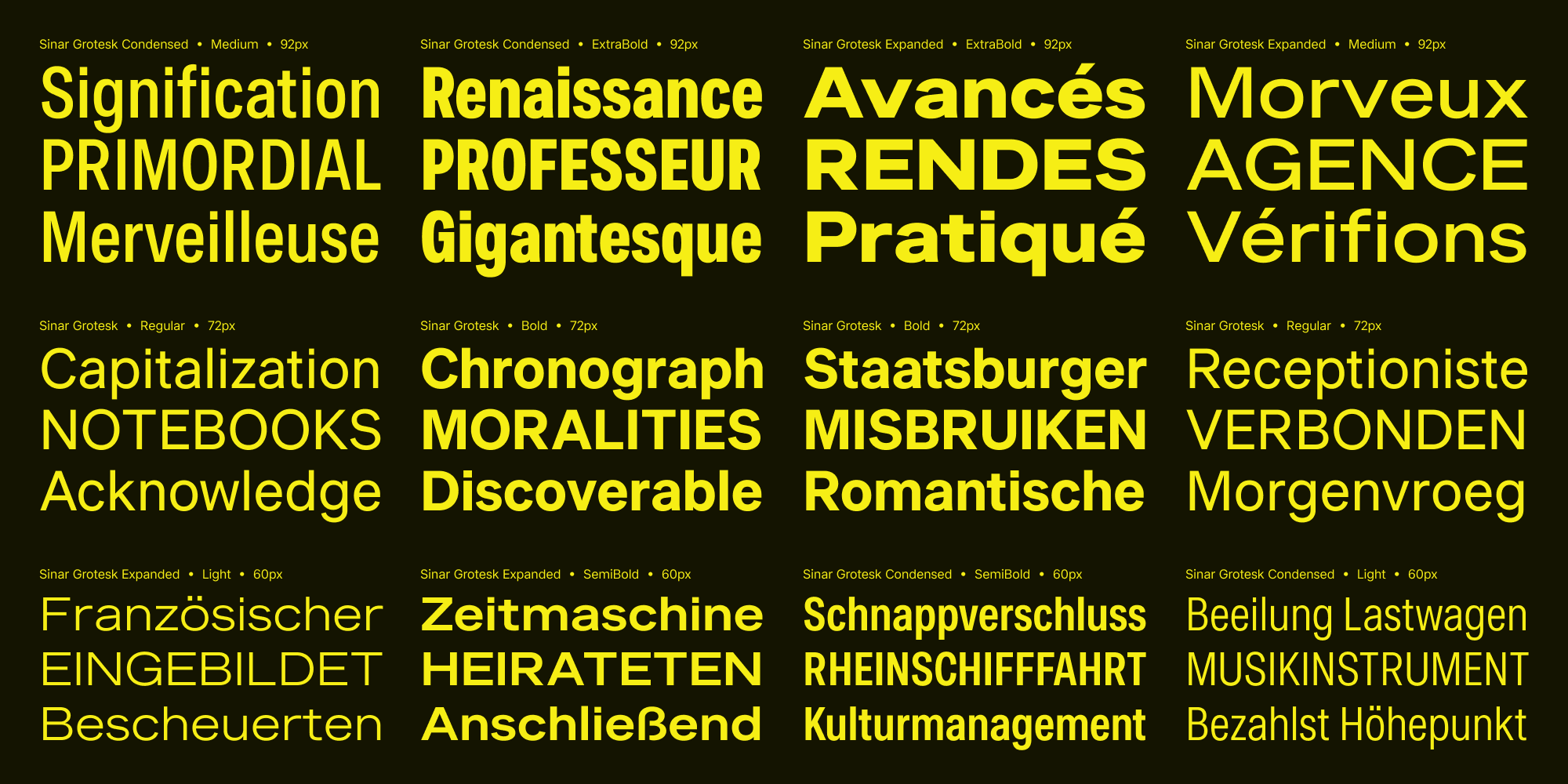
Sinar Grotesk Styles

Uprights

ExtraLight

Light

Regular

Medium

SemiBold

Bold

ExtraBold

Black

Sinar Grotesk Styles

Italics

ExtraLight Italic

Light Italic

Italic

Medium Italic

SemiBold Italic

Bold Italic

ExtraBold Italic

Black Italic

Variable

400px

0px

1em

Conference

400px

0px

1em

Automation

400px

0px

1em

Copyrighted

400px

0px

1em

Supercritical

48px

0px

1.2em

The primary properties of light are intensity, propagation direction, frequency or wavelength spectrum, and polarization. Its speed in vacuum, 299792458 m/s, is one of the fundamental constants of nature. All electromagnetic radiation exhibits some properties of both particles and waves.

24px

0px

1.4em

Light, visible light, or visible radiation is electromagnetic radiation that can be perceived by the human eye. Visible light spans the visible spectrum and is usually defined as having wavelengths in the range of 400–700 nanometres (nm), corresponding to frequencies of 750–420 terahertz. The visible band sits adjacent to the infrared (with longer wavelengths and lower frequencies) and the ultraviolet (with shorter wavelengths and higher frequencies), called collectively optical radiation. In physics, the term "light" may refer more broadly to electromagnetic radiation of any wavelength, whether visible or not. In this sense, gamma rays, X-rays, microwaves and radio waves are also light. This is why visible radiation is commonly termed visible light. The primary properties of light are intensity, propagation direction, frequency or wavelength spectrum, and polarization. Its speed in vacuum, 299792458 m/s, is one of the fundamental constants of nature. All electromagnetic radiation exhibits some properties of both particles and waves. Single, massless elementary particles, or quanta, of light called photons can be detected with specialized equipment; phenomena like interference are described by waves. Most everyday interactions with light can be understood using geometrical optics. Quantum optics is an important research area in modern physics. The main source of natural light on Earth is the Sun. Historically, another important source of light for humans has been fire, from ancient campfires to modern kerosene lamps. With the development of electric lights and power systems, electric lighting has effectively replaced firelight.

16px

0px

1.4em

The Centennial Light is an incandescent light bulb recognized as the oldest known operating light bulb. It was first illuminated in 1901, and has only been turned off a few brief times since. It is located at 4550 East Avenue, Livermore, California, and is open to public viewing. Due to its longevity, the bulb has been noted by The Guinness Book of World Records, Ripley's Believe It or Not!, and General Electric. The light has been the subject of many TV shows and news reports along with at least four books, and has its own website. The handmade lightbulb was originally manufactured by the Shelby Electric Company of Shelby, Ohio, towards the end of the 1890s and donated to the Livermore-Pleasanton Fire Department in 1901. It has been relocated several times since and remains in the care of the fire department to this day. The bulb's longevity has been attributed to the high quality of its manufacture, it being seldomly turned off, and its low wattage. Originally a 60-watt bulb, the light has weakened over the years and now emits a dim light equivalent to a 4-watt bulb, about the strength of a typical nightlight. The Centennial Light was originally a 60-watt bulb, but has since dimmed significantly and is now as bright as a 4-watt bulb. The hand-blown, carbon-filament common light bulb was invented by Adolphe Chaillet, a French engineer who filed a patent for this socket technology. It was manufactured in Shelby, Ohio, by the Shelby Electric Company in the late 1890s; many just like it still exist and can be found functioning. According to Zylpha Bernal Beck, the bulb was donated to the Fire Department by her father, Dennis Bernal, in 1901. Bernal owned the Livermore Power and Water Company and donated the bulb to the fire station when he sold the company. That story has been supported by firefighter volunteers of that era. Evidence suggests that the bulb has hung in at least four locations. It was originally hung in 1901 in a hose cart house on L Street, then moved to a garage in downtown Livermore used by the fire and police departments. The bulb was saved during the fire station's 1937 renovation, during which it was off for approximately one week. Its unusual longevity was first noticed in 1972 by reporter Mike Dunstan. After weeks of interviewing people who had lived in Livermore all their lives, he wrote "Light Bulb May Be World's Oldest", published in the Tri-Valley Herald. Dunstan contacted the Guinness Book of World Records, Ripley's Believe It or Not, and General Electric, who all confirmed it as the longest-lasting bulb known in existence. In 1976, the fire department moved to Fire Station #6 with the bulb; the bulb socket's cord was severed for fear that unscrewing the bulb could damage it. It was deprived of electricity for only 22 minutes during the transfer, which was made in a specially designed box and with full firetruck escort.
Solid Outline
Glyph Name
Character Name
Unicode Decimal
Unicode Hex

About Font

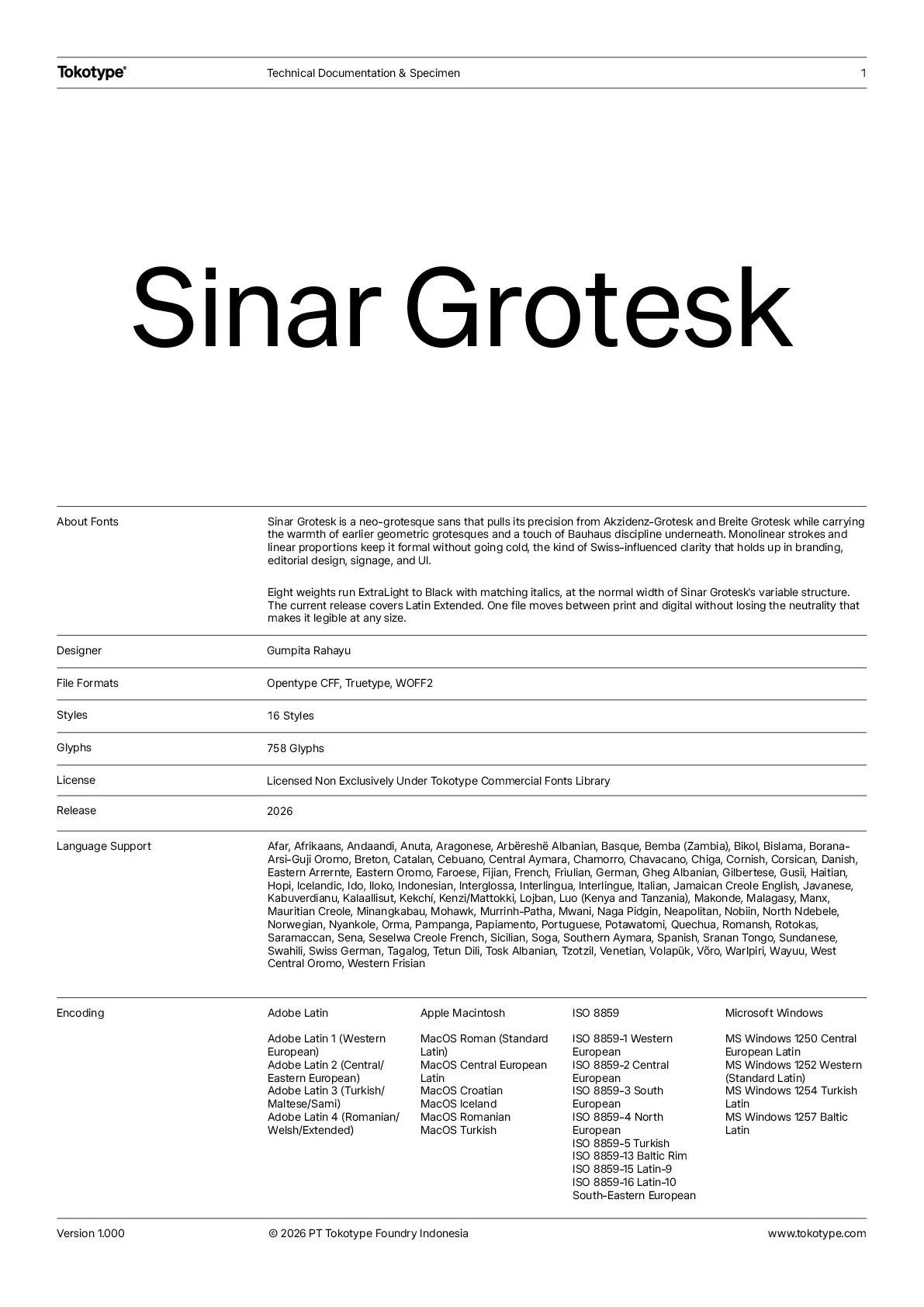
Sinar Grotesk is a neo-grotesque sans that pulls its precision from Akzidenz-Grotesk and Breite Grotesk while carrying the warmth of earlier geometric grotesques and a touch of Bauhaus discipline underneath. Monolinear strokes and linear proportions keep it formal without going cold, the kind of Swiss-influenced clarity that holds up in branding, editorial design, signage, and UI. Eight weights run ExtraLight to Black with matching italics, at the normal width of Sinar Grotesk's variable structure. The current release covers Latin Extended. One file moves between print and digital without losing the neutrality that makes it legible at any size.

Font Information

Collections

16 Styles – Variable

Version

1.2

File Format

OTF, TTF, WOFF2

Designers

Gumpita Rahayu

PDF Specimen

PDF Specimen

Language Supports

Afar
Afrikaans
Andaandi
Dongolawi
Anuta
Aragonese
Arbëreshë Albanian
Asturian
Atayal
Basque
Bemba (Zambia)
Bikol
Bislama
Borana-Arsi-Guji Oromo
Bosnian
Breton
Catalan
Cebuano
Central Aymara
Chamorro
Chavacano
Chiga
Cook Islands Māori
Cornish
Corsican
Creek
Czech
Danish
Eastern Arrernte
Eastern Oromo
Faroese
Fijian
French
Friulian
Ganda
German
Gheg Albanian
Gilbertese
Gusii
Haitian
Hopi
Hungarian
Hän
Icelandic
Igbo
Iloko
Indonesian
Italian
Jamaican Creole English
Javanese
Jola-Fonyi
Kabuverdianu
Kaingang
Kala Lagaw Ya
Kalaallisut
Kekchí
Kenzi
Mattokki
Kirmanjki
Latgalian
Lower Sorbian
Luo (Kenya and Tanzania)
Makonde
Malagasy
Maltese
Manx
Maori
Mauritian Creole
Minangkabau
Mohawk
Montenegrin
Murrinh-Patha
Mwani
Naga Pidgin
Neapolitan
Nobiin
North Azerbaijani
North Ndebele
Northern Sami
Norwegian
Nyankole
Orma
Pampanga
Papiamento
Polish
Portuguese
Potawatomi
Quechua
Romanian
Romansh
Rotokas
Samoan
Saramaccan
Sena
Serbian
Seselwa Creole French
Sicilian
Slovak
Slovenian
Soga
Southern Aymara
Southern Sotho
Spanish
Sranan Tongo
Sundanese
Swahili
Swiss German
Tagalog
Talysh
Tetun Dili
Tokelau
Tonga (Tonga Islands)
Tosk Albanian
Tsakhur
Tuvalu
Tzotzil
Upper Sorbian
Venetian
Vietnamese
Võro
Walser
Warlpiri
Wayuu
West Central Oromo
Western Frisian
Yoruba
Zapotec

Related Family

Sinar Grotesk Condensed

Learn More

16 Styles – Variable

Sinar Grotesk Expanded

Learn More

16 Styles – Variable

Download Trial Fonts for Free

Take our fonts for a spin! Enter your name, email address, and the font of your choice. Then, you can download it directly and start testing it for your project.